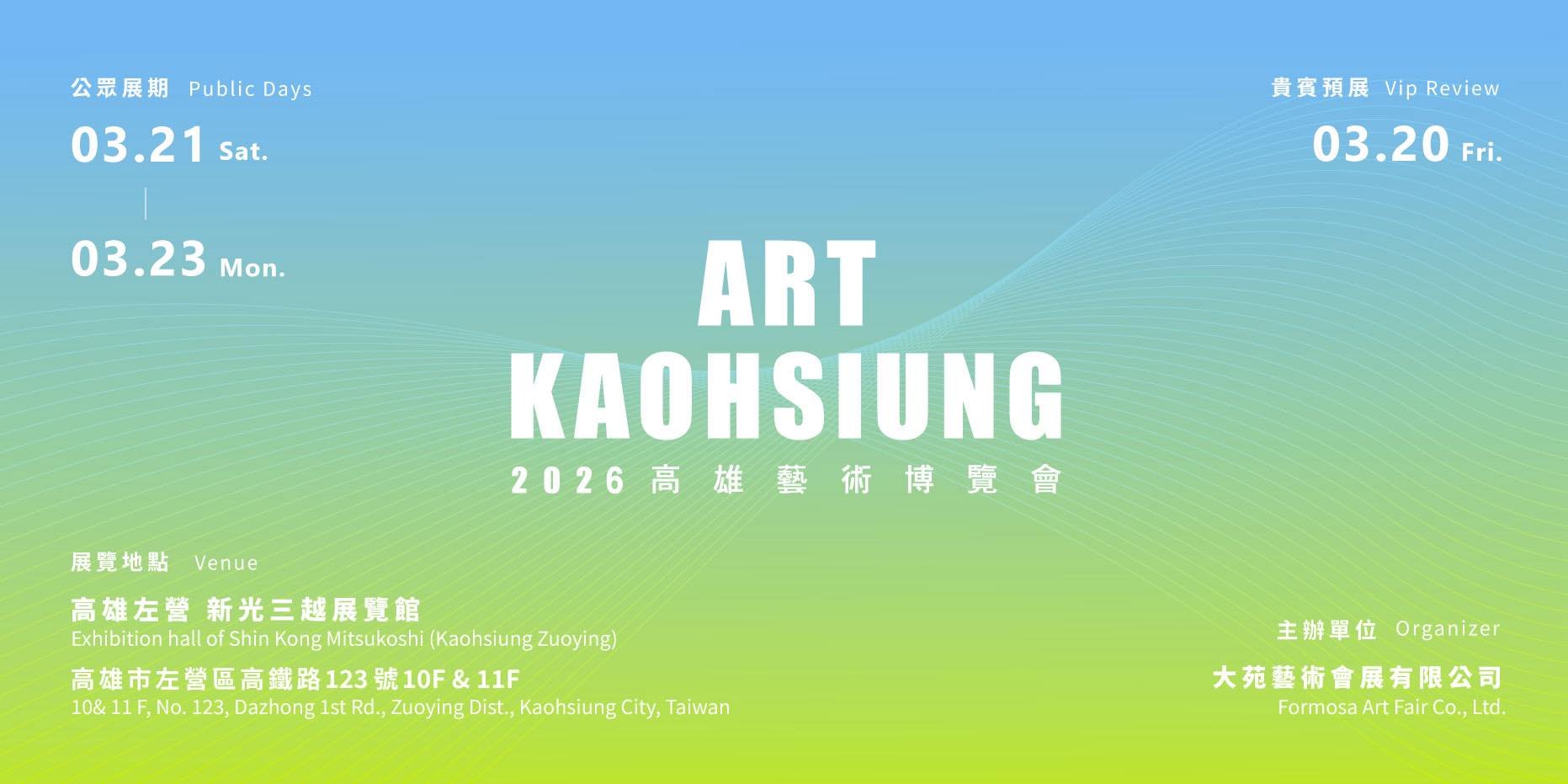
ART KAOHSIUNG

ART KAOHSIUNG 高雄藝術博覽會自2013年開創以來,秉持對藝術的使命感與熱忱,在產官學各界的期盼與支持之下,2014年以「東南亞及東北亞藝術交會平台」為定位,精心規劃多元豐富的展覽及講座活動,悉心耕耘台灣南部藝術市場及展業,結合產官學三方力量,成功開啟台灣藝術市場新區塊,為台灣南方藝文產業譜出新篇章!

ART KAOHSIUNG 作為南台灣的標竿藝術盛會,邀集高雄在地畫廊、藝文中心與藝術家參與,並持續融合與開發亞洲的藝術交流潛力,搭建國內與歐洲藝術產業之合作橋樑,廣邀知名策展人及畫廊業者與會,串連台灣中南部之藝術資源,延續港邊國際氛圍的氣勢,打造高雄城市文化藝術名片。

與會的國際畫廊遍及歐亞地區,廣泛來自日本、韓國、馬來西亞、泰國、香港、越南、俄羅斯、緬甸、中國與法國等,每年為台灣南部藝術產業、藝術愛好者與眾多藏家帶來藝術泉源,於台灣南部成功帶動當代藝術市場流動。

粉絲專頁:https://www.facebook.com/ARTKAOHSIUNG/

Founded in 2013, ART KAOHSIUNG has upheld a strong sense of mission and passion for arts. With the expectations and support from the public, private, and academic sectors, the fair positioned itself in 2014 as a “Platform for the Convergence of Southeast and Northeast Asian Art.” Through carefully curated exhibitions and a diverse range of forum programs, ART KAOHSIUNG has cultivated the art market and industry in southern Taiwan. By integrating resources from industry, government, and academia, the fair has successfully opened a new sector in Taiwan’s art market and written a new chapter for the cultural and creative industries in the region.

As a landmark art event in southern Taiwan, ART KAOHSIUNG brings together local galleries, art institutions, and artists from Kaohsiung, while continuously expanding artistic exchange across Asia. It also serves as a bridge for collaboration between Taiwan and the European art industries, inviting renowned curators and gallery professionals to participate. By connecting art resources throughout central and southern Taiwan and embracing Kaohsiung’s harbor-side international atmosphere, the fair aims to establish a distinctive cultural and artistic identity for the city.

Participating international galleries come from across Europe and Asia, including Japan, South Korea, Malaysia, Thailand, Hong Kong, Vietnam, Russia, Myanmar, China, and France. Each year, ART KAOHSIUNG brings a vibrant source of artistic energy to southern Taiwan’s art industry, art enthusiasts, and collectors, successfully stimulating the circulation and development of the contemporary art market in the region.
FACEBOOK:https://www.facebook.com/ARTKAOHSIUNG/

“Hidden Dragon: Emerging Artists Exhibition” 

A New Generation of Artistic Energy in Taiwan

In the rapidly shifting landscape of contemporary art, the emergence of young artists has become a focal point for museums, galleries, and art fairs worldwide. Across Europe, North America, and Asia, cultural institutions are increasingly establishing dedicated programs to identify and support artists at the early stages of their careers. These initiatives not only nurture new talent but also serve as vital indicators of the future direction of contemporary art. Presented within this international context, the Hidden Dragon: Emerging Artists Exhibition at the 2026 Art Kaohsiung Art Fair offers a platform for a group of promising Taiwanese artists whose practices signal the evolving energy of a new generation.

The title “Hidden Dragon” draws inspiration from “I Ching,” where the phrase “Hidden Dragon” refers to latent power that has yet to fully reveal itself. As a curatorial concept, it suggests a moment of quiet potential—artists whose creative forces are still being developed but already demonstrate compelling originality. The artists selected for this project have recently gained recognition through major art competitions in Taiwan, including the Kaohsiung Award, the Taipei Fine Art Award, the CTBC Painting Prize, the Grand View Emerging Artists Award, the Chung-Shan Youth Art Award, and the Luminous Art Marketing award.

These awards have long served as key platforms for identifying emerging voices in Taiwan’s contemporary art scene. Historically, many artists who later achieved international recognition were first discovered through such competitions. In this sense, art awards function not only as milestones within an artist’s career, but also as important markers for observing the emergence of new artistic movements.

The Hidden Dragon: Emerging Artists Exhibition brings together eleven artists: LIN Yi-Hsuan, WANG Chung-Ping, LIN Shih-Yung, LEE Fang-Yu, CIOU Zih-Yan, CHANG Kai-Hsuan, CHEN I-Long, WU Hui-Chun, CHANG Chen-Wei, YEH Jhe-Yu, and WANG Po-Chin. Their creative forms encompass painting, sculpture, and installation art, showcasing the diverse and open creative environment for young Taiwanese artists.

Observing the artworks, it can be seen that this generation of artists is no longer limited to a single form, but pays more attention to cross-media and cross-disciplinary creative approaches. Painting is no longer just a traditional two-dimensional representation, but connects with narrative, psychological perception, and contemporary video culture; sculpture and installation emphasize the interaction between spatial sense, bodily experience, and environment.

This shift in creative language also reflects a common trend in contemporary art worldwide—art is no longer just a This shift in creative language also reflects a common trend in contemporary art worldwide—art is no longer just a form's exploration, but a comprehensive response to social, cultural, and personal experiences.

These art awards have long been regarded as an important platform for observing contemporary Taiwanese art. Many artists active on the international art scene today were discovered through art competitions in their early careers. Therefore, competitions are not only important milestones in an artist's career, but also important clues for observing the development of a new generation of art.


International Perspective: The Rise of New Generation Artists

The rise of  new generation artists has become a significant phenomenon in the global art market. Many art fairs and galleries are actively looking for the next generation of promising creators.

For example, British artist Flora Yukhnovich gained considerable attention from international galleries and auction markets around the age of thirty, transforming classical Rococo painting language into fluid and energetic abstract scenes.

For example, British artist Flora Yukhnovich gained significant attention from international galleries and the auction market in her early thirties. Her work transforms the visual language of classical Rococo painting into fluid and dynamic abstract compositions.

Another example is Ghanaian painter Amoako Boafo, whose highly distinctive portraits quickly entered the international art market and were acquired by several major museums.

Another notable artist is Jadé Fadojutimi, who secured major museum exhibitions in her twenties, and whose vibrantly colored abstract paintings quickly attracted collectors' attention.

The rise of these artists shows the increasing importance the contemporary art world places on "young creative energy." Many collectors and art institutions are beginning to support artists early in their careers, hoping to witness the long-term value of their creative development.

This trend is equally evident in Asia. Art fairs in Hong Kong, Seoul, and Singapore have recently included dedicated sections showcasing emerging artists. These platforms often become important venues for collectors and galleries to discover the next generation of artists.

In this context, the "Hidden Dragon" exhibition also provides an important window into the development of Taiwan's new generation of art.


Diversity of Artistic Languages ​​in the New Generation

The participating artists in the present exhibition demonstrate a high degree of diversity in medium and expressive methods.

In painting, artists such as LEE Fang-Yu and LIN Yi-Hsuan explore emotions, memories, and everyday experiences through delicate pictorial language. Their artworks often establish a fluid relationship between figuration and abstraction, giving the paintings a dual layer of narrative and poetry. Similar qualities are also seen in WANG Chung-Ping's photographic practice. LIN Shih-Yung and CHANG Kai-Hsung's artworks focus more on space and formal structure. Through the rhythm and composition of their paintings, they establish a philosophically meaningful viewing experience.

On the other hand, sculpture and installation also occupy an important place among these artists. CHANG Chen-Wei's sculptures emphasize the characteristics of materials and spatial interaction, showcasing the exploration of spatial perception by a new generation of sculptors; CIOU Zih-Yan, through installation and video works, focuses on urban culture and social structures, creating a more direct connection between art and contemporary life. This cross-form and cross-sphere approach to creation demonstrates the open attitude of young Taiwanese artists in the international art context.


“Hidden Dragon” Artists’ Potential for Future Development

In the art market, early works by many important artists are often discovered by sagacious collectors before they receive vast attention. For collectors, the artworks of new generation artists not only represent creative energy but also possess long-term cultural value.

The "Hidden Dragon" exhibition provides a rare platform, allowing viewers and collectors to observe the creative landscape of Taiwan's new generation artists in the same space. From painting to sculpture, from narrative to abstract, these artworks collectively constitute an emerging cultural landscape.

Art history often reveals its trajectory only in retrospect. Many important art movements originated from groups of creators who rose to prominence in the same period, such as the Parisian avant-garde art of the early 20th century, the New York art scene of the 1960s, or the emerging artists of London in the 1990s.

It may be too early to determine the trajectories their careers will take. However, it is clear that their artworks already reveal a creative energy that deserves close attention.

Meanwhile, artists such as Lin Shih-Yung and Chang Kai-Hsuan approach painting through structural and spatial considerations. Their works emphasize rhythm, composition, and visual tension, constructing contemplative environments that invite viewers to reflect on the act of perception itself.


Sculpture and installation also play an important role within this generation. Chang Chen-Wei’s sculptural practice focuses on the physical properties of materials and their interaction with surrounding space, exploring how form can reshape spatial awareness. Ciou Zih-Yan’s installations, by contrast, engage with urban culture and social structures, incorporating moving images and spatial interventions to examine the relationship between contemporary life and visual representation.


Such interdisciplinary approaches reflect a broader transformation in contemporary artistic practice. Today’s artists often work across boundaries—between media, between disciplines, and between personal and collective narratives. This openness to experimentation positions Taiwan’s younger artists within a wider global conversation.


The international art world has increasingly recognized the significance of emerging artists. Collectors, curators, and institutions are paying closer attention to artistic practices at earlier stages of development, acknowledging that the most influential voices of the future often appear long before widespread recognition.

In recent years, several artists illustrated this phenomenon. The British painter Flora Yukhnovich gained international attention for her reinterpretation of Rococo painting, transforming historical visual language into energetic contemporary abstraction. Similarly, Ghanaian painter Amoako Boafo rose rapidly within the international art market through his distinctive portraiture, while the work of Jadé Fadojutimi has attracted major institutional exhibitions at a remarkably young age.

The success of such artists reflects a broader shift in contemporary art’s ecosystem. Collectors and institutions increasingly recognize the importance of supporting artists during the formative stages of their careers. Early engagement allows not only to discover new artistic languages but also to witness the long-term development of an artist’s vision.


Similar trends are visible across Asia. Art fairs in cities/countries such as Hong Kong, Seoul, and Singapore now feature dedicated sections for emerging artists, creating spaces where international audiences can encounter new creative voices.

Within this context, the Hidden Dragon: Emerging Artists Exhibition offers an important window into the evolving landscape of contemporary art in Taiwan. By presenting a group of artists whose practices span diverse media and conceptual approaches, the project highlights the vitality and experimentation that characterize the new generation.

Art history often becomes visible only in retrospect. Many influential artistic movements—from the Parisian avant-garde of the early twentieth century to the London-based Young British Artists of the 1990s—emerged from communities of artists working simultaneously yet independently. At the time of their emergence, few could predict the long-term impact these artists would eventually have on the global art scene.

The artists gathered within the Hidden Dragon: Emerging Artists Exhibition stand at a similarly formative moment. Their practices differ widely in medium, theme, and aesthetic approach, yet they share a common sense of exploration and openness.

It may be too early to determine the trajectories their careers will take. What is clear, however, is that their works already reveal a creative energy that deserves close attention.

As these hidden dragons gradually rise, new artistic forces begin to take shape.